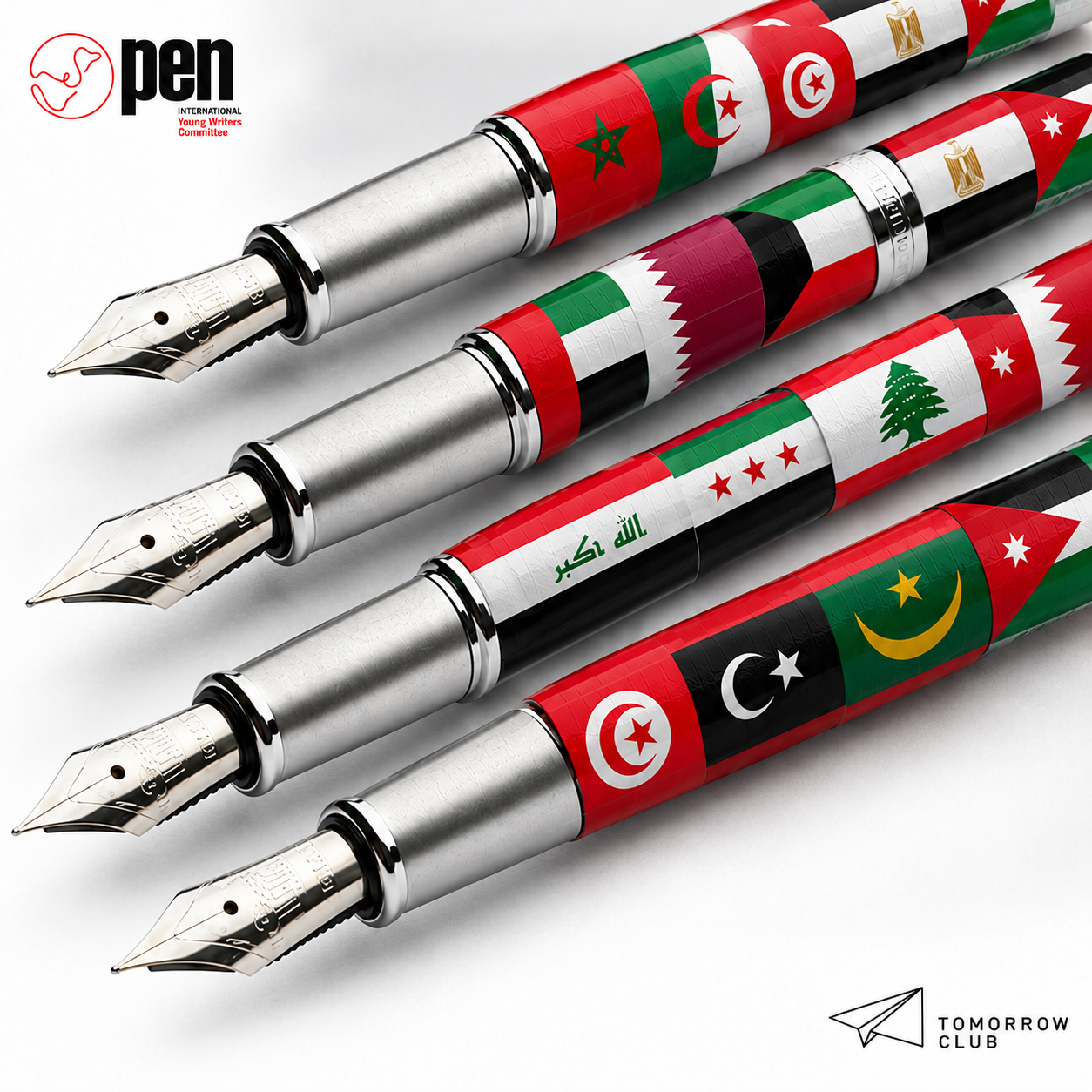
The texts gathered in this collection do not speak with one voice.
Although the writers featured in this collection belong to the same generation—all under the age of thirty-five—their voices are remarkably diverse. Their texts arise from different countries, different literary sensibilities, and contrasting ways of seeing the world. Yet, when read together, they reveal a shared landscape: a region where identity is constantly negotiated, where memory resists erasure, where loss becomes language, and where literature remains one of the last spaces in which human experience can be examined without simplification.
Across these pages, the Middle East is not presented as a political abstraction; rather, young writers transform it into a constellation of intimate worlds.
In Haneen Khalil's Syrian prose, identity survives displacement through the most ordinary of rituals. Food becomes an archive of belonging, and Makdous is transformed from a simple dish into a vessel of collective memory, carrying an entire homeland within the gestures of preparation and sharing. There, culture is preserved not only in monuments and histories but also in kitchens, conversations, and inherited tastes. In Wael Al-Qadri's haunting Syrian story The Complete Painting: The Breach , the landscape of war intrudes upon a painter's search for beauty. What begins as a meditation on colour, light, and artistic creation becomes a confrontation with destruction, memory, and loss.
Lebanese texts return repeatedly to the question of place and resistance to land occupation and erasure. In Riyasa Ismail's poem, the figure of the southern woman carries history on her shoulders, walking between war, faith, exile, and resilience. Mahmoud Wehbe's meditation on the destroyed city of Khiam transforms a wounded geography into a dialogue with memory itself, where ruins, absences, and inherited losses continue to shape the present. The city becomes both a physical place and a repository of unresolved histories.
Iraqi contributions reveal another dimension of contemporary experience. In Ehab Shghedl's poetry, personal memory intersects with the turbulent chronology of a nation, while Amer Al Tayyeb's ironic and poignant "Democracy’s High Ceiling" exposes the distance between political promises and lived realities. Here, poetry becomes a language through which public life is examined, questioned, and reimagined.
Questions of dignity and inequality emerge with particular force in Kholoud Mokhtari's essay from Morocco. Her text is a testimony against forms of violence that do not always leave visible scars: public shaming, institutional pressure, and the gendered mechanisms through which power attempts to silence dissent. Literature here becomes an act of resistance and witness.
In a very different register, Othman Derdabi approaches mortality itself, turning cemeteries into spaces of philosophical inquiry where the boundaries between the living and the dead become strangely porous.
Palestinian texts are haunted by exile, inheritance, and the search for freedom. In Hadeer Al-Barkooni's poem, love and displacement intertwine until the beloved becomes another form of homeland. Huda Helassa explores the geography of fate and the invisible borders that precede individual choice, while insisting that freedom remains an inner act of courage rather than a destination. Their writings remind us that identity is never merely inherited; it is also continuously contested and recreated.
Finally, Ahmed El-Rodiny's long poem returns us to one of literature's oldest questions: what can poetry do in the face of oppression? His imprisoned poet preserves names, stories, and dreams against the machinery of forgetting. The notebook buried beneath the tree becomes a metaphor for literature itself: fragile, endangered, yet capable of outliving those who attempt to silence it.
Read together, these texts form a cartography of contemporary Middle Eastern experience.
They speak of war and exile, but also of food, love, humour, memory, and everyday endurance.
They ask questions about belonging, justice, mortality, gender, and freedom without pretending to offer definitive answers.
Above all, they demonstrate that young writers across the region continue to transform personal experience into artistic exploration, creating works that are deeply rooted in local realities while speaking to universal human concerns.
This collection is therefore more than an anthology. It is a conversation across borders, languages, and histories—a reminder that literature remains one of the most powerful ways of understanding both ourselves and one another.