➣Originally published on Sage Journals by Index on Censorship, Volume 55, Issue 1, April 2026.
THREE YEARS AGO
I moved to Britain from my native Russia. Ten years ago, I became a member of the feminist protest and performance art group Pussy Riot.
But before all that, you may be surprised to learn I was a policewoman.
“Scram, quick, from here on in it only gets worse.” I heard that sort of thing a lot at the age of 18, after I started working for the Police Patrol and Checkpoint Service in St Petersburg.
How did my colleagues, who had worked in the system all their lives, see me? “This young chick breezed in, wearing nail extensions and a pink puffer jacket.” How did I see myself? Inspired by the TV series Dexter, I made believe that I was Debra Morgan – a real tough cookie who kicked bad-guy butt. I wanted to be like that.
When they asked me why I’d decided to “throw my life away on policing junkies and alcoholics, instead of just joining them”, I talked about justice. About protecting the public. About helping people. They answered me with a condescending pat on the shoulder. “An innocent kid,” they said.
I joined an outfit that was 80% men. The older ones played at “fathers” with me and the young ones worked on polishing their pick-up skills. Dirty jokes and misogyny were the norm. If you felt uncomfortable with that, then you were in the wrong place.
I became a junior sergeant, with two gold stripes on my shoulders. It seemed to me that a representative of authority should have an aura of sternness, but I didn’t have any. “Olya, you’re a cop. You’re a cop,” I used to repeat to myself. And, thanks to my theatrical past, it worked. “You are now committing a civil offence,” I would declare with supreme confidence as I approached yet another group of people drinking beer outside a metro station.
You come to realise that you have a right to make demands. A right to arrest people. You represent power. The very moment when you put on your uniform and start feeling your power is when your professional deformation begins. Setting aside your own existential suffering, helping those who genuinely need your help really does bring a sense of satisfaction.
But everything that this system is built on is wrong. The reforms of the noughties didn’t actually change anything. The militia became the police and the uniform changed colour from grey to navy blue, while the bureaucracy increased and remained in the hands of people with the same old worldview, who still exploit it every day to further their own interests.
One day, after the usual “standard check”, our unit commander started finding fault with my employment record book. He claimed that I’d pulled the thread out of it myself, which was absolute nonsense – I’d simply been issued with one like that. And that wasn’t the first time he’d suddenly accused me of something. When he left, I walked under an archway with one of my colleagues and cried, because I couldn’t understand why the commander was treating me like that. You’ve probably never seen cops cry.
More and more often I caught myself thinking that the one thing I was most afraid of in this life was becoming like them: hard-boiled cynics, discontented and envious. Or like my poor colleague, who never took bribes: a wretched whipping-boy, standing there soaked-through in the rain. As I snivelled under that archway, trying to light a slim cigarette with trembling fingers, my partner advised me simply to tough it out until our commander turned his attention to someone else.
That answer didn’t satisfy me back then, at the age of 19. And now I understand that the real problem wasn’t that I was a girl. That causes more problems – you have to stand up for yourself – but it isn’t the root cause of everything. The real problem is the chain of power and coercion. You just put up with it all until eventually you rise high enough for the roles to be reversed.
Another year would go by before I left the police. When I arrived at the base to collect my things, my unit commander – the same man who had kept picking on me, the same man who had got drunk, lost all his personal documents, including his police ID card, and ended up in a car crash – told me condescendingly: “Well now, Olya, I always knew this wasn’t your thing.”
The real problem is the chain of power and coercion. You just put up with it all until eventually you rise high enough for the roles to be reverseded
Only a few months later I would join my first demonstration. And my first protest was also an act of mourning. Politician Boris Nemtsov had been murdered only metres away from the Kremlin. He had been critical of President Vladimir Putin’s provocative aggression against Ukraine. He had been the voice of Russians who opposed war, a charismatic individual about whom I knew almost nothing. But when I saw on Twitter that this opposition politician had been shot in the centre of Moscow, I couldn’t simply stop there.
I started avidly reading everything about the opposition movement in Russia. While I was gathering my documents to join the police, Pussy Riot were beaten with whips by Cossacks in Sochi. While I was trying to prove to myself that I could be a good cop, people in Russia were protesting against Putin. The number of political prisoners grew, new repressive laws were passed, opposition leader Alexei Navalny’s websites were blocked. I learned about a huge community that fought against injustice, cast light on the trials of artists, put together aid parcels for people who were arrested, organised protest demonstrations and wanted a different future for Russia.
The resounding slogans “Russia without Putin!” and “Freedom for political prisoners” hung in the air everywhere; they swept right round the cities of Russia. And I really liked that. I became an activist.
At the age of 21
I moved to Moscow, enthralled by the idea of doing something important together with people who thought the same way I did. I devoured news and history. I read about the war in Chechnya, about murdered civil rights activists, about terrorist attacks, about how they were starting to extinguish freedom of speech. The more I read, the more obvious it became that these tragic events are not isolated instances. They’re interconnected. This understanding gave me a strange feeling of firm ground under my feet. It didn’t make me physically stronger but it gave me a definite stance: I have the right to make a political statement.
I started working with political prisoners. We provided legal aid and told them about the new political trials every day. It’s impossible not to burn out doing this kind of work – reading about torture in the prison camps, talking to the relatives of people jailed for posts on Facebook. By the time you’ve helped one, they’ve arrested another six.
They say growing up means accepting the fact that the world is unjust. That injustice is part of the order of things. And the longer you resist, the more painful your fall will be. But you’re bound to fall anyway. The world is unjust, but that doesn’t mean you shouldn’t listen to your own heart.
Five years went by like this. I carried on going to meetings and taking part in protests. I saw someone receiving a suspended sentence for disagreeing with the authorities as a victory or a miracle. Would you be prepared to sacrifice five years of your life for a post on the internet? More and more people left the country. The West introduced sanctions against Russia following the annexation of Crimea, but people in Europe carried on shaking Putin’s hand while in Crimea activists were being abducted. “We are deeply concerned.” Thank you.
The 2018 World Cup was held in Russia. Not a single European country boycotted it. That same summer, in the Central African Republic, the forces of “Putin’s chef”, Yevgeny Prigozhin, killed a group of Russian journalists who went there to shoot a documentary about Putin’s interests in Africa.
Two months later, my friend Petya Verzilov was poisoned with military nerve gas. Because he had spoiled Putin’s party by organising a protest in which he and other members of Pussy Riot ran on to the pitch during the final of the World Cup, or because he was due to fly out to the Central African Republic? I don’t know. But understanding the non-random nature of the chain of tragic events no longer provided me with a firm footing. I started envying people who weren’t interested in that. “After all, you could simply live a normal life. What can you change?” my mother said.
Two years later, Navalny was poisoned with a similar toxin. It was a miracle he survived.
Peering into the future of my country was more frightening than any movie.
Putin started bombing Ukraine. A war began. No, that’s wrong… My country started a war. People in Kyiv slept in the metro stations with their nursing infants. Russian soldiers shot people in Bucha. Mariupol was almost totally destroyed. This was very painful and terrifying. I didn’t know how to stop it.
This is how Maria Alekhina and I described it in the book we wrote, Political Girl:
“Paralysis. Numbness. Fear. Numbness. Pain. Numbness. What are you called, devils? We’re called words you didn’t know before. We’re called missile strike, we’re called shelter. We are called the army of the fucking Russian Federation.”
All these years we’d been saying that Putin wouldn’t stop unless we knocked him back hard. I had to accept in my heart that the point we had reached now meant this was impossible.
Like many of my friends, I left the country.
I bought a one-way ticket to Georgia. I didn’t have a plan but a plan found me. My friend Masha from Pussy Riot called me. She invited me to join an anti-war tour around Europe, where we would collect money for a Ukrainian hospital. At that moment she was under house arrest in Moscow, facing her second criminal charge. But she dressed up in the green uniform of a food delivery girl, escaped from the house that was surrounded by cops and got across the border.
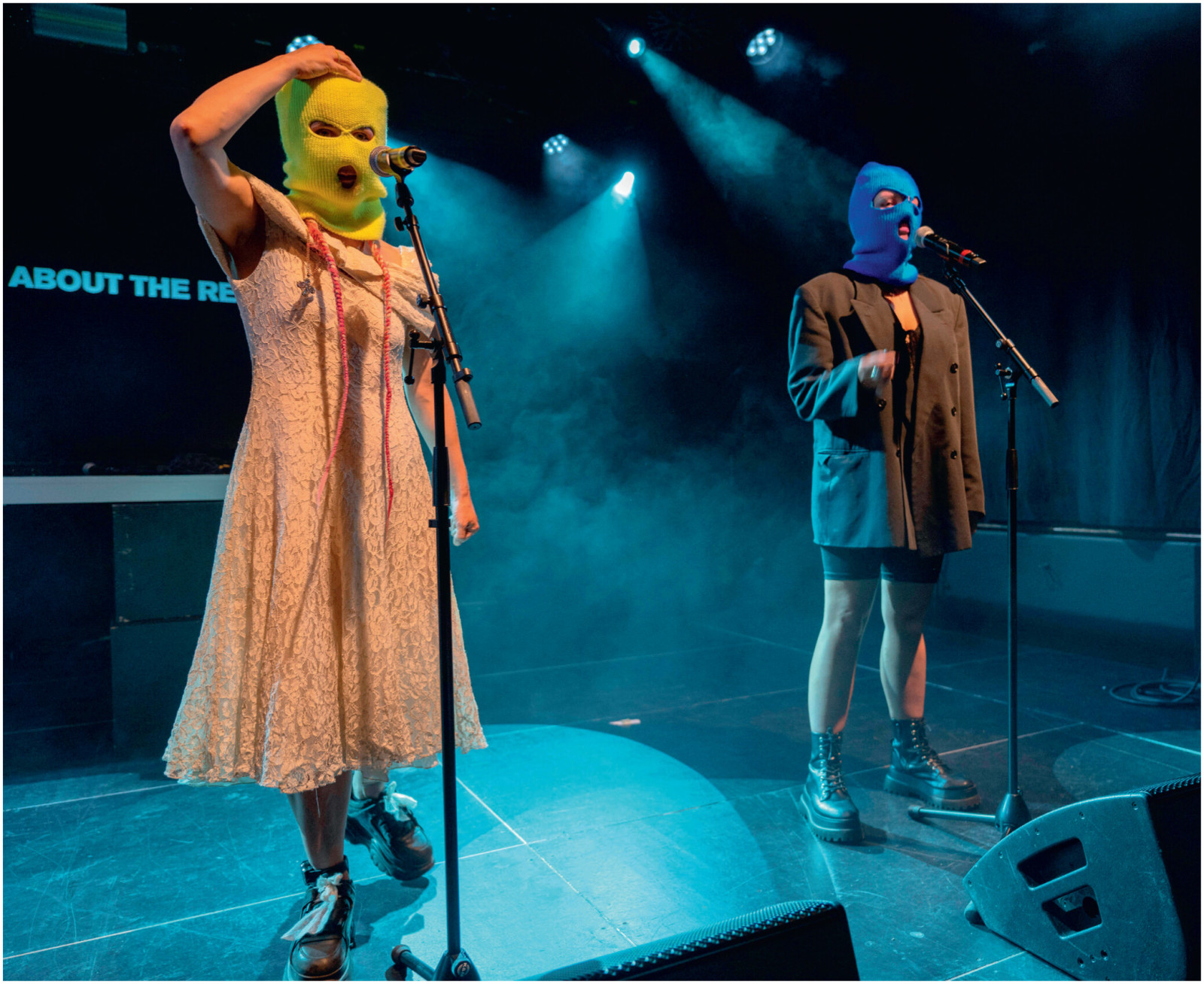
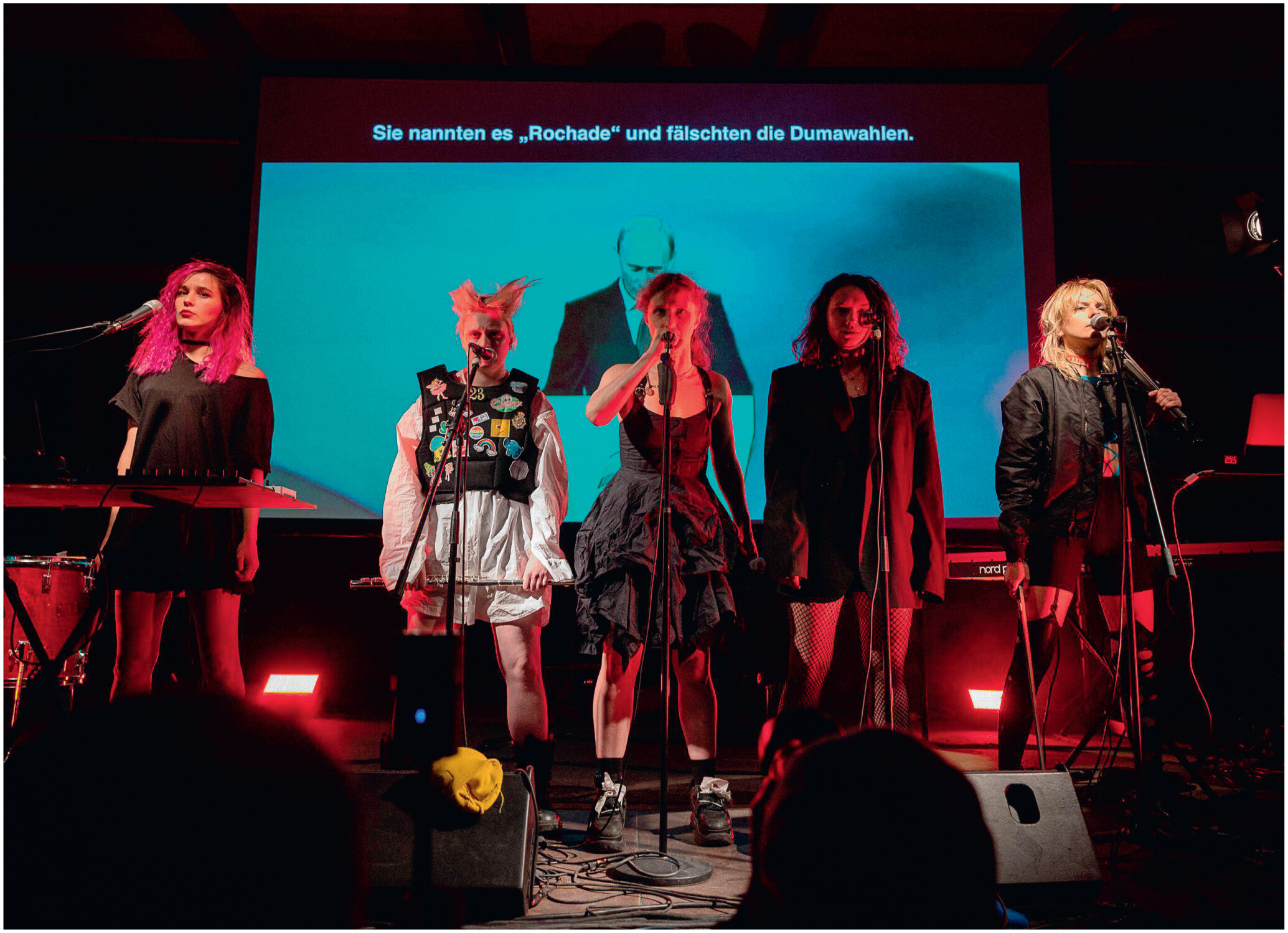
For almost three years we performed our show Riot Days – four girls in a van without any official ID, without a plan, without a home. But the shared goal of doing at least something useful before our country slithered down into fascism justified our existence.
For more than two years now I’ve been glancing out of the window, trying to imbibe someone else’s sense of home. During the first year of the war there was still the casual attitude of “Well, we don’t know when it will end. Maybe the war will be over in a month”. But the moment arrived when I realised that what was happening in Russia couldn’t be ended with the signing of some document or other. That we have no future as a society if we don’t serve penance for this war, if we don’t help to restore everything that we have destroyed, if we don’t give back what we tried to seize by force.
I miss my home, my parents, my friends. I remember the feel of everything in my flat. I can close my eyes and touch the tablecloth on the table in the living room, feel the coldness of the door handle in my room.
In today’s Russia, to be against the war is a crime. I can’t go back home. Last year, I was sentenced in my absence to eight years in prison. If I had killed someone and I had enough money for a good lawyer, I’d probably have been given a shorter sentence.
My native country is preserved in my memory as a mosaic of doors, traffic lights on familiar streets, tastes, bus stops, songs and smells. When I see blogs with streets that I know, I gaze at them for a long time, as if I’m peering through a little window at another planet I can never go to. I try not to romanticise things. The bottom line is that my country chewed me up and spat me out.
The world is unjust, it’s true. But that doesn’t absolve you from the need to make a choice. I don’t regret a single decision I’ve made. I’m at liberty. I don’t have to engage in self-censorship. I can carry on working and speaking out. It’s not a matter of victory. I haven’t won any victory. But I didn’t submit, and that is enough.